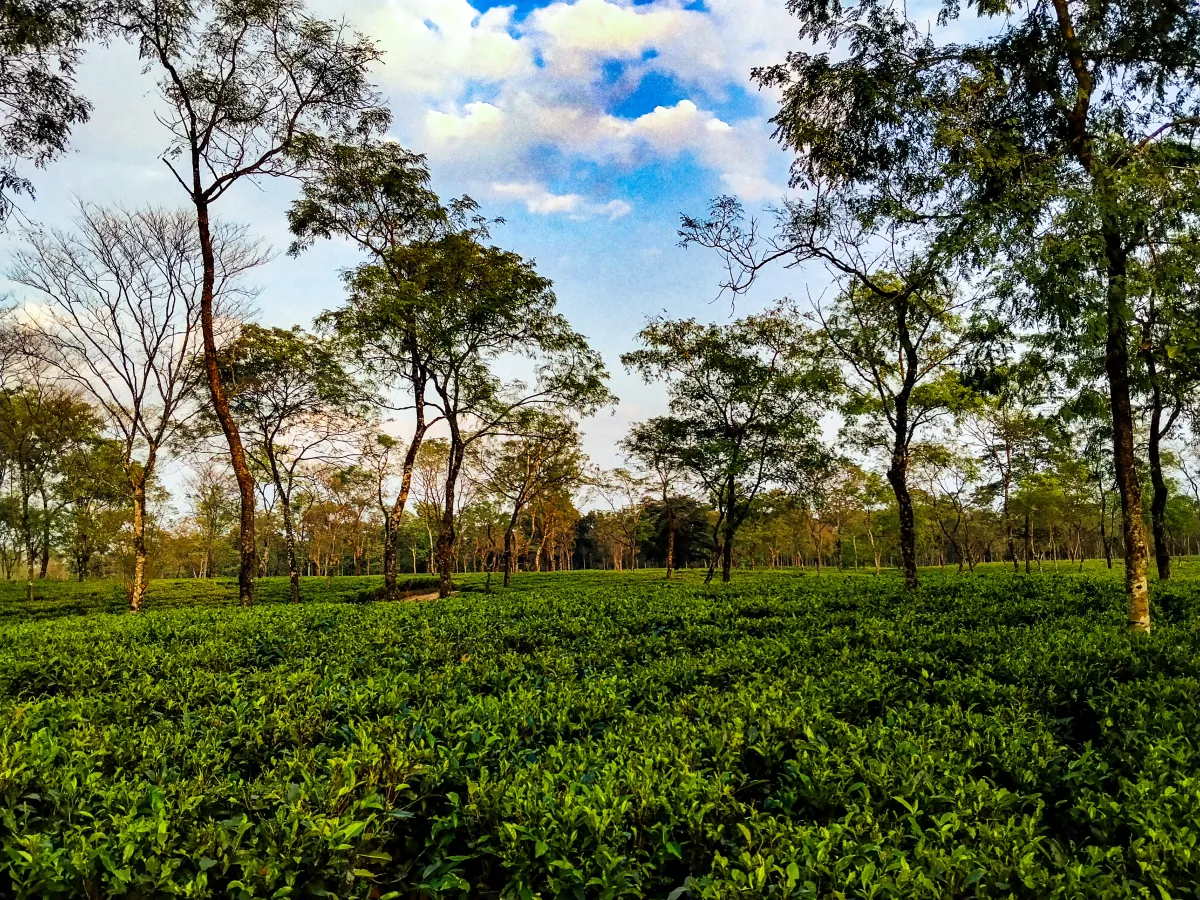
Have You Heard of Mandalgaon?
Most people who plan a trip to Dooars end up in Lataguri or Gorumara. These are great places, and there is nothing wrong with going there. But if you are the kind of traveller who likes to go a little further, find a little more quiet, and skip the weekend crowd — then you need to know about Mandalgaon.
Mandalgaon is a small village in the Samsing area of Kalimpong district, tucked into the foothills of the Eastern Himalayas. It sits right at the edge of Neora Valley National Park — one of the most biodiverse forests in West Bengal. And it is almost completely unknown to mainstream tourism.
That is exactly what makes it special.
Where Exactly Is Mandalgaon?
Mandalgaon sits in the Dooars foothills at an elevation of roughly 835 to 1,200 metres above sea level. It is part of the Samsing Fari locality in Kalimpong district, West Bengal.
It is not on the main highway. You have to take a narrow hill road that winds up through the Samsing village settlement — past small houses with orange-red tin roofs, bamboo groves, and kitchen gardens — before reaching the hilltop. That winding road is not a hassle. It is a sign that you are going somewhere worth going.
How to Reach Mandalgaon
- From NJP (New Jalpaiguri): About 95–100 km, roughly 3 hours by car via Chalsa and Samsing
- From Siliguri: Similar distance and time
- From Bagdogra Airport: Around 2.5 to 3 hours by car
- From Kolkata: Take an overnight train to NJP, then hire a car to Mandalgaon
Ask your driver for Mandalgaon Shiv Mandir — it is the local landmark on the hill road and most drivers in the Samsing area will know it.
What Does Mandalgaon Look Like?
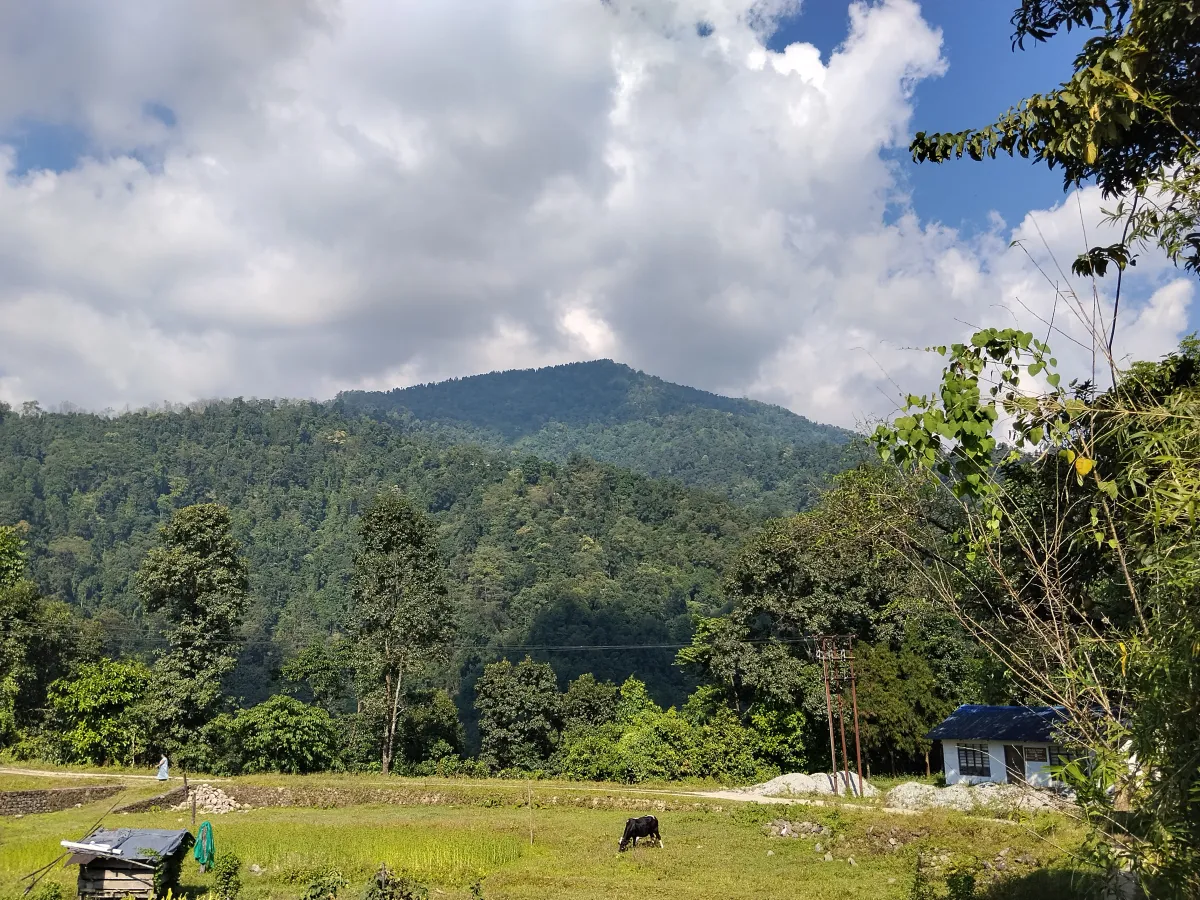
Imagine standing on a forested hilltop completely surrounded by jungle. In every direction, all you can see is ridge after ridge of thick green forest. No buildings on the horizon. No city glow. No highway noise. Just trees, hills, and open sky.
That is Mandalgaon.
The terrain here is dramatic. The hillsides are steep, the ravines are deep, and the forest is continuous broadleaf jungle — not a plantation, not a park with trimmed walking paths, but actual sub-tropical forest that is full of life. The Samsing and Mandalgaon settlement sits in a small cluster on the mid-slope, but it is completely surrounded by this wild green landscape.
"At Mandalgaon, you are not next to nature. You are inside it. There is a real difference, and you feel it immediately."
What Are the Nearby Landmarks?
Once you are in Mandalgaon, you will find several viewpoints and landmarks within easy reach. Here is a quick overview:
| Landmark | Direction from Homestay |
|---|---|
| Chakle View Point | North, uphill along the ridge — faces Neora Valley |
| Infinity Viewpoint | South, below — sweeping view over the Dooars plain |
| C.N.I Church, Samsing | West, along the ridge road |
| Murti River | North-East, in the valley below the hill |
| Ruka Forest | South-West — deeper, less-visited forest zone |
| Upper Tangta Football Ground | North, on the higher ridge |
To the north-east of Mandalgaon, the Murti River flows through the valley below. It is a glacier-fed river coming down from the Himalayan foothills, and on quiet mornings you can actually hear it from the hilltop.
That sounds like a small thing. But when you have spent enough time in cities where the background noise is always traffic or construction, hearing a river from a distance feels genuinely different. It is one of those things that makes you realise how quiet this place actually is.
The Murti River is also brilliant for birdwatching. The riverbanks and surrounding forest create a diverse habitat where many different bird species can be spotted — especially early in the morning.
"You wake up in the morning, and somewhere below the hill, the Murti River is running. You can hear it before you see it. That kind of quiet is hard to find."
The Two Viewpoints — Two Very Different Views
Chakle View Point (North, Uphill)
This viewpoint is located above the homestay along the upper ridge, looking northward toward Neora Valley National Park. The view is dense forest going up into the Himalayan foothills — deep, quiet, and slightly vertiginous. It is not a viewpoint you will find on travel websites, but locals know it well. A short uphill walk rewards you with one of the best forest views in the Samsing area.
Infinity Viewpoint (South, Below)
The Infinity Viewpoint faces south over the Dooars plains. On a clear day, the flat green expanse of the Dooars stretches out below you as far as you can see. The contrast is striking — thick forested hill behind you, vast open plain ahead. The name makes sense once you are standing there.
The Forest Around Mandalgaon
The forest surrounding Mandalgaon is sub-tropical broadleaf jungle. This is not a managed or maintained forest. It is working, living jungle — with a full canopy, understorey shrubs, mosses and ferns on the ground, and a huge variety of species at every level.
The Ruka Forest to the south-west is the deeper, less-visited part of this forest system. The Neora Valley National Park buffer zone begins at the upper edge. Together, these forests create an unbroken green corridor that runs from the Dooars plains all the way up into the Himalayan foothills.
Because of this altitude gradient, Mandalgaon has unusually high bird diversity. You get plains birds, foothill birds, and Himalayan winter migrants — all in the same area.
Birds You Can Spot Around Mandalgaon
- Rufous-bellied Niltava
- Chestnut-crowned Laughingthrush
- Blue-naped Pitta
- Fire-tailed Myzornis
- Satyr Tragopan (in deeper forest areas)
- Various Babblers, Flycatchers and Laughingthrushes
Birders who visit the Samsing area regularly rate it as one of the best birdwatching spots in North Bengal. Early mornings and late afternoons are the best times to head out with binoculars.
What Is the Night Sky Like Here?
Because Mandalgaon is far from any town, the night sky here is genuinely dark. No light pollution, no orange glow from a city on the horizon. On moonless nights, the Milky Way is clearly visible.
After dark, the forest sounds take over — insects, nightjars, the occasional animal call from further in the jungle. If you are used to city nights with traffic noise and artificial light, the first night at Mandalgaon takes some adjusting to. By the second night, you will not want to leave.
Best Time to Visit Mandalgaon
October to February — Best Season
This is the clearest time of year. The monsoon is over, the sky is clean, wildlife activity is high near water sources and birdwatching is at its best as winter migrants come down from higher elevations. The Murti River is clear and its sound carries far in the dry air. Highly recommended for first-time visitors.
March and April — Spring
The forest starts to bloom. Wildflowers come up on the forest floor, bird breeding season begins, and mornings are active and noisy in the best possible way. The temperature is comfortable and the whole landscape feels like it is waking up. A great time to visit if you want colour and energy.
May and June — Pre-Monsoon
Gets warmer in the lower areas but the forest stays lush and green. Bird activity is still very high. The pre-monsoon sky gives dramatic sunsets from the hilltop. Good season for those who do not mind a bit of heat.
July to September — Monsoon
Roads can get tricky, and leeches are present on forest trails — fair warning. But the landscape during monsoon is something else entirely. Every ridge turns deep green, mist fills the ravines every morning, and the Murti River runs loud and fast. Some travellers actually prefer this season because almost nobody else comes.
"The monsoon does not make Mandalgaon less beautiful. It just makes it wilder. The forest is more alive in the rain than it ever is on a sunny afternoon."
Mandalgaon vs Lataguri — Which Should You Choose?
Lataguri is the right choice if you are visiting Dooars for the first time, want a structured jeep safari into Gorumara, need comfortable hotel options, and prefer a place with easy connectivity and lots of food choices.
Mandalgaon is the right choice if you have already been to Lataguri (or want to skip the crowd from the start), prefer staying in a quiet hilltop homestay over a resort, are seriously interested in birdwatching or nature photography, and want complete 360-degree jungle immersion.
They are not competing with each other. They are two completely different kinds of experiences.
"Lataguri will show you Dooars. Mandalgaon will make you feel it."
A Quick Note on Travelling Responsibly Here
Mandalgaon sits at the edge of active wildlife corridors. Elephants, leopards, and bears move through the forests near this village. It is not a managed tourist zone — it is a real ecosystem with a small community living inside it.
A few simple things make a real difference when you visit:
- Stay at a local homestay rather than visiting for just a day trip
- Do not litter on the hill road or forest trails
- Keep noise low, especially near the forest edge
- Support local businesses and guides directly
Places like Mandalgaon stay beautiful because not many people come, and the ones who do come respectfully. Keep that going.
Final Thoughts
Mandalgaon is not famous. It will not show up in the top results when you search for Dooars travel packages. There is no resort here, no jeep safari queue, no souvenir shop.
What it has is a forested hilltop with 360-degree jungle views, a glacier-fed river running through the valley below, a night sky full of stars, and birdsong from before sunrise.
If that sounds like your kind of trip — Mandalgaon is waiting for you. Go before it gets discovered.
"The best travel destinations are always the ones you find just before everyone else does."